AI SEO Is the Future: What the Data Actually Shows
I've been watching the AI SEO shift for months now. The data tells a story most people are still ignoring.
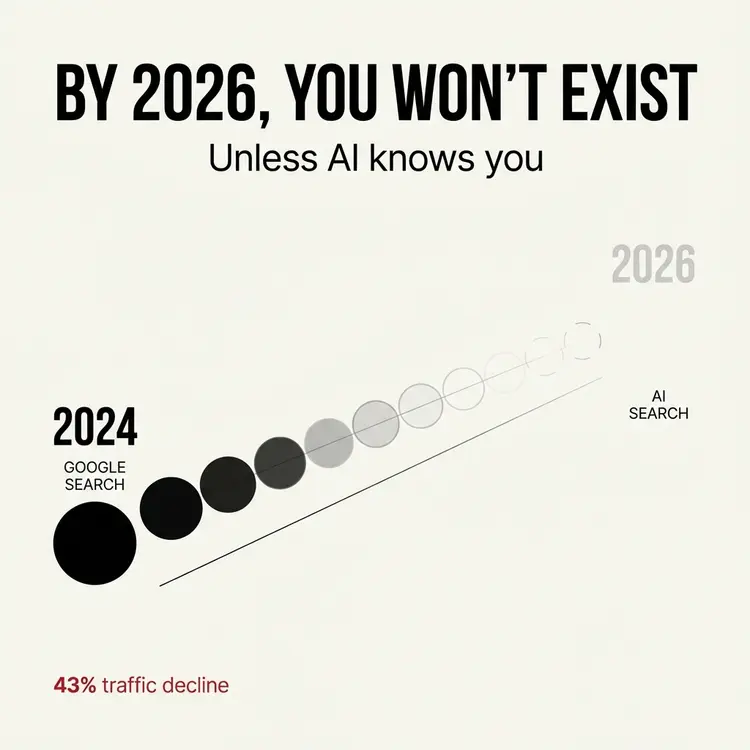
Around 93% of AI Mode searches end without a click. Organic CTR has dropped 61% for queries with AI Overviews—from 1.76% to just 0.61%.
The game changed. We just haven't caught up yet.
The Numbers Don't Lie About Where Search Is Going
Half of consumers use AI-powered search today. By 2028, this shift could impact $750 billion in revenue.
Google already shows AI summaries in about 50 percent of searches. That number climbs to more than 75 percent by 2028.
The brands unprepared for this shift may see traffic from traditional search channels decline anywhere from 20 to 50 percent.
ChatGPT's market share exploded 740% in 12 months. From 0.25% of the global search market in early 2024, Search GPT now holds 2.1% of total search traffic in 2025.
ChatGPT gets over 5 billion monthly visits. It ranks as the fourth most visited website globally.
Traditional SEO Metrics Are Losing Their Power
Here's what caught my attention: the drop in top-10 citation rate from 76% to 38%.
Ranking on page one of Google no longer guarantees AI citations. AI systems pull from diverse source types—Reddit threads, niche authority sites, structured data sources that may not even appear in traditional top-10 results.
The solution requires a dual strategy. Maintain traditional ranking for queries where AI features are absent. Optimize content structure, citation worthiness, and entity relationships for AI citation.
Content depth and readability matter most for securing AI mentions and citations. Traditional SEO metrics like traffic and backlinks have little impact.
ChatGPT favors content that uses definite language, contains question marks, has high entity density, balances facts and opinions, and uses simple writing structures.
The Citation Economy Replaces the Click Economy
Brands cited in AI Overviews earn 35% more organic clicks and 91% more paid clicks.
The competition model inverted completely.
Structured content improves ChatGPT visibility. Comparison pages with 3 tables earn 25.7% more citations. Validation pages with 8 list sections earn up to 26.9% more citations. Shortlist pages averaging 10 words or fewer per sentence earn 18.8% more citations.
Nearly 35% of Gen Z people in the U.S. use AI chatbots to search for information. Adoption rates in lower-income countries are over four times higher than in high-income countries.
This represents a fundamental transformation in how people discover information.
AI-Written Content Already Dominates Results
AI-written pages now appear in over 17% of top search results.
AI content can rank well, but it remains vulnerable to algorithm changes. The winning formula combines AI with human insights and experiences.
Content created with AI often starts showing up in search results in two months or less.
Currently, 31% of marketers use generative AI extensively for search engine optimization. Another 25% use it partially—meaning over 56% of organizations actively integrate AI into their SEO workflows.
Additionally, 45% of these organizations plan to use generative AI extensively for search engine optimization in the next 2-3 years.
But there's a dangerous disconnect: 43% of marketers optimize for AI search in 2026—but only 14% measure it.
The Technically Invisible Crisis
While 94% of brands invest heavily in traditional SEO, 62% are "Technically Invisible" to Generative AI models.
When asked direct, unbranded questions about their core services, AI models failed to cite them in 81% of test cases.
Organic click-through rates for informational queries have declined by 61% since the rollout of AI Overviews.
You can continue to optimize for a search engine that is slowly losing market share. Or you can optimize for the AI agents that will control the next decade of commerce.
The brands that survive 2026 will establish themselves as the Trusted Entity—the source of truth that AI relies on to construct its reality.
Google Has Been AI-Powered Since 2013
Google has been weaving AI into its ranking systems since 2013. The recent changes made the AI visible to end users.
The ranking system has been AI-powered for years.
Hummingbird (2013) introduced semantic understanding. RankBrain (2015) added machine learning. BERT (2019) brought deep natural language understanding to 100% of English queries. By 2024, AI Overviews put generative AI directly in search results. In 2025, AI Mode made Google Search fully conversational.
If your SEO strategy only accounts for AI Overviews, you're looking at the last few steps of a long-running project.
The Market Opportunity Is Massive
The AI SEO tools market is experiencing explosive growth. Projected to skyrocket from USD 1.2 billion in 2024 to an impressive USD 4.5 billion by 2033.
This represents a Compound Annual Growth Rate of 15.2% from 2026.
The AI SEO tools market will more than triple its value in less than a decade.
65% of businesses have noticed better SEO results with AI implementation. AI use allows companies to publish 47% more content each month. 68% of marketers confirm that AI helped them achieve higher ROI.
What This Means for Your Strategy
The shift to AI search fundamentally reshapes how brands get discovered.
Traditional rankings still matter for queries without AI features. But citation worthiness, content structure, and entity relationships determine visibility in AI responses.
The brands winning in 2026 will do three things:
Build for citations, not just clicks. Structure content to be cited by AI systems. Use definite language, high entity density, balanced facts and opinions, and simple writing structures.
Measure AI visibility. Track citations in AI Overviews, ChatGPT, and other AI search tools. Monitor which content gets cited and why.
Establish trusted entity status. Become the source AI systems rely on for your domain. This requires consistent, authoritative content that AI models recognize as credible.
The data shows where search is going. The question is whether you'll adapt before your competitors do.
AI SEO represents the future of search engine optimization. The brands that recognize this early will capture the market share others lose while they wait.
Want to create content like this at scale while keeping your authentic voice?