Your Competitors Are Already Invisible (And You Might Be Next)
I watched something strange happen last month.
A friend asked me to recommend the best conversion optimization expert in Phoenix. I opened ChatGPT and typed: "Who are the top 3 conversion optimization consultants in Phoenix?"
Three names appeared. None of them were the person I was about to recommend.
My friend—who's spent 13 years building expertise, has a client roster most consultants would kill for, and genuinely knows more about conversion psychology than anyone I know—didn't exist in that answer.
He was invisible.
The Crossover Point Is Already Here
According to recent data, ChatGPT now processes over 2.5 billion prompts per day with 800 million weekly active users. The platform holds 81% market share in the generative AI space.
But here's what most people miss.
This isn't about ChatGPT growing. It's about traditional search dying.
Google searches per user dropped nearly 20% year-over-year in the United States. Publishers globally experienced a 33% decline in Google search traffic from November 2024 to November 2025.
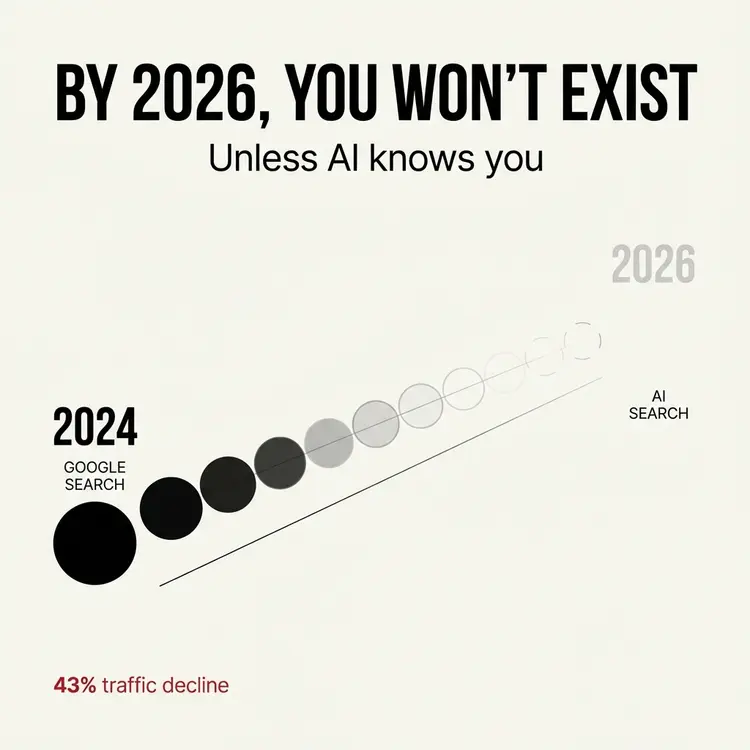
The SEMrush data shows the inflection point: sometime around mid-2026, AI search will surpass all traditional SEO searching.
We're not preparing for a future shift. We're living through it right now.
The Zero-Click Apocalypse
Over 60% of all Google searches no longer lead to a click.
Think about that for a second.
You spend months optimizing your content. You rank on page one. Someone searches for exactly what you offer. Google's AI Overview answers their question. They never click through to your site.
When AI Overviews appear in search results, organic click-through rates plummet from 1.76% to 0.61%—a 61% decline.
Your visibility doesn't convert to customer sales anymore. It converts to nothing.
But AI Search Traffic Actually Converts
Here's where it gets interesting.
ChatGPT-referred traffic to U.S. retail sites converted at 11.4% compared to just 5.3% for organic search.
People using AI search arrive with higher intent and clearer context. They've already had a conversation. They've refined their needs. They know what they're looking for.
The average ChatGPT user types 348 words per conversation—nearly 70 times longer than a typical Google search query.
These aren't casual browsers. These are people doing real research, making real decisions, and looking for real expertise.
The Invisible Majority
I've had this conversation with dozens of entrepreneurs over the past few months.
I ask them: "Have you ever gone to ChatGPT and asked for the best expert in your field?"
Almost everyone raises their hand.
Then I ask: "Can you agree it would be important to make sure that when someone searches for the best person in your market and category, your name shows up instead of a competitor?"
They all agree.
But most of them have no idea how to make that happen.
The seasoned entrepreneurs get it immediately. They've been trying to get visibility through social media posting, blog writing, YouTube videos. They see that there might be a better path.
The ones who don't see it yet are still trapped on the content treadmill. They believe that if they just post more—once a day became three times a day became five times a day—they'll break through.
They won't.
What AI Actually Understands
AI doesn't rank you based on how much you post.
It doesn't care about your follower count, your engagement rate, or how many reels you've published this week.
AI understands structured intelligence.
When someone asks ChatGPT or Perplexity or Gemini for an expert recommendation, these systems scan for encoded knowledge. They look for frameworks, mental models, proof points, decision patterns, and expertise domains that have been captured in a way they can process.
If your expertise exists only in your head, in scattered social posts, or in unstructured blog content, AI can't find it. It can't understand it. It can't recommend you.
You're invisible.
The Cognitive Debt Problem
Most entrepreneurs I talk to are already using AI to create content.
They're outsourcing their thinking to ChatGPT. They're letting AI write their posts, their emails, their articles.
This creates what I call cognitive debt.
Every time you let AI think for you instead of capturing how you think, you lose a piece of your intellectual property. You train the AI on generic patterns instead of your unique expertise.
The entrepreneurs who will thrive in this AI search era understand something fundamental: you need to own your intelligence before you can leverage AI.
Building Your Founder Intelligence Moat
My co-founder Zach and I built TwinBrain because we saw this shift coming.
Zach has expertise in vibe coding and building multi-agent AI systems. I've spent years studying human behavior, conscious AI use, and how to extract maximum performance from people across all markets.
We both sit on the board of the AZ AI Syndicate. We've watched AI programs and communities explode. We've seen which entrepreneurs adapt and which ones disappear.
The pattern became clear: the entrepreneurs who encode their thinking into structured intelligence create a strategic moat that AI can actually understand and recommend.
TwinBrain interviews you about your expertise. It builds a knowledge graph of how you think—your frameworks, your mental models, your decision patterns, your unique insights.
Then it uses that encoded intelligence to generate content that sounds authentically like you, optimized for both human readers and AI discovery.
You're not just creating content. You're building a searchable representation of your expertise that AI systems can find, understand, and recommend.
The Choice You're Actually Making
Publishers surveyed by Reuters Institute expect search traffic to decline by an average of 43% over the next three years.
HubSpot now reports that just 10% of leads come from blog traffic, down from what was once the majority of their pipeline.
The old playbook is dead.
You can keep posting more. You can keep optimizing for traditional SEO. You can keep hoping that your next viral post will change everything.
Or you can encode your expertise into structured intelligence that AI systems can actually find and recommend.
The entrepreneurs who understand this shift are already building their moats. They're capturing their thinking. They're creating knowledge graphs of their expertise. They're making themselves visible in the systems where their ideal clients are already searching.
The ones who don't adapt will watch their competitors get recommended instead.
What Happens Next
By mid-2026, most entrepreneurs will be invisible.
Not because they lack expertise. Not because they don't create content. Not because they aren't working hard enough.
They'll be invisible because AI doesn't understand them.
The shift from traditional search to AI search is the biggest change in how people find expertise since Google launched in 1998.
You're either encoding your intelligence or losing it.
There's no middle ground.
Want to create content like this at scale while keeping your authentic voice?