The AI Agent Takeover Is Already Here
I've been watching the AI space long enough to know when something real is happening.
This is real.
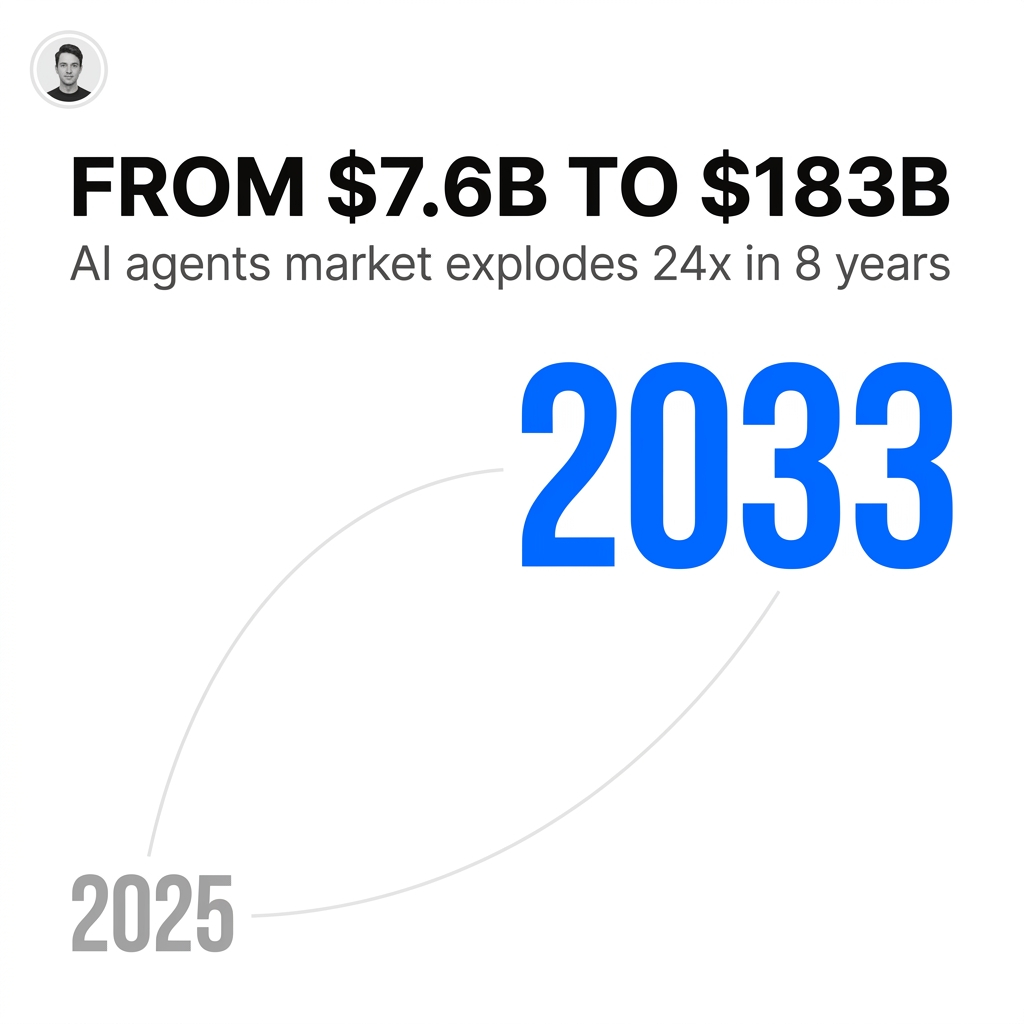
The AI agents market was worth $7.63 billion in 2025. By 2033, it will hit $182.97 billion. That's 24x growth in eight years.
You don't see numbers like that unless the entire game is changing.
2026: The Year Everything Shifted
People are calling 2026 the year of the AI agents. 70% of companies in North America already use agentic AI. More than 4 in 10 organizations have AI agents in production right now.
This happened faster than anyone predicted.
I remember when businesses were still figuring out basic automation. Now they're deploying agents that make decisions, adapt in real time, and collaborate with other agents. The shift from "let's try this" to "we can't operate without this" took about 12 months.
That's the fastest enterprise technology adoption we've seen in a decade.
What Changed
AI agents don't follow instructions. They understand goals.
Traditional automation runs on fixed rules. You tell it exactly what to do, step by step. AI agents figure out how to reach an outcome. They adjust when things change. They work with other agents to solve problems you didn't anticipate.
Businesses stopped automating tasks. They started replacing entire workflows.
Suzano, the world's largest pulp manufacturer, built an AI agent that reduced query handling time by 95% for 50,000 employees. JPMorgan Chase saved 360,000 hours of manual work annually. These aren't small improvements. These are fundamental changes to how work gets done.
The SaaSpocalypse
In February 2026, Anthropic released plugins for its Claude Cowork AI agent.
The market lost $285 billion in software value within days.
Investors realized one AI agent could do the work of dozens of human seats. The per-user pricing model that built the SaaS industry started crumbling. When one agent replaces 20 subscriptions, the math changes fast.
I've built in the SaaS space. I know how those business models work. This disruption is real, and it's permanent.
The Numbers Tell the Story
By 2026, 40% of enterprise applications will include task-specific AI agents. These agents will form a new coordination layer where different types work together to run core business workflows at scale.
The productivity gains are staggering. Industry forecasts predict AI agents will automate up to 70% of office work tasks within the next decade. McKinsey estimates this could unlock $2.9 trillion in economic value by 2030.
Generative AI took three years to reach 70% adoption.
Agentic AI reached 35% adoption in two years, with another 44% of organizations planning deployment soon.
This is unprecedented.
What This Means for How We Work
I've spent years helping businesses think through automation. The conversation used to be about saving time on repetitive tasks. Now it's about restructuring entire organizations.
Among organizations with extensive agentic AI adoption, 45% expect reductions in middle management layers. When agents handle coordination, decision-making, and execution, the traditional hierarchy stops making sense.
Genentech built agent ecosystems on AWS to automate complex research workflows. Scientists focus on breakthrough drug discovery while agents handle the operational complexity. Amazon used Amazon Q Developer to coordinate agents that modernized thousands of legacy Java applications.
These are multi-agent systems. Specialized agents collaborating across functions. One agent handles data analysis. Another manages compliance. A third coordinates with external systems. They work together without human intervention for most decisions.
The Solo Revolution
Solopreneurs are using AI agents to do the work of 10-person teams.
Legal, accounting, architecture. Fields people said were "too complex" for automation. A single person with a good agent framework can compete with established firms.
I've seen this firsthand. Small businesses that couldn't afford full teams now operate at enterprise scale. The barrier to entry dropped to near zero for anyone willing to learn how agents work.
The Reality Check
Here's what people miss when they talk about AI agents.
This is about thinking, not just productivity.
I've built TwinBrain around a simple idea: AI should think like you, not write for you. The agents that win are the ones that understand how you approach problems, make decisions, and see patterns. Generic automation creates generic results.
The businesses succeeding with AI agents aren't just plugging in tools. They're teaching agents their specific way of working. Their frameworks. Their judgment calls. Their edge.
Authenticity matters more now than ever.
When 70% of companies use the same AI tools, differentiation comes from how you think. The agents that capture your actual reasoning process multiply your impact. The ones that just follow templates make you replaceable.
What Happens Next
The market is moving faster than most people realize.
By 2030, AI agents will be embedded in every part of business operations. The companies that figure out how to work with agents now will have a massive advantage. The ones that wait will spend years catching up.
I'm not saying this to hype the technology. I'm saying it because the data is clear and the shift is already happening.
Small businesses have a window right now. Before the big players lock down the market. Before the best practices become rigid. Before everyone figures out what works.
You can build agent systems that reflect how you actually think. That capture your expertise. That scale your judgment without diluting it.
Or you can wait and use whatever generic solution becomes standard.
The Bottom Line
AI agents are replacing workflows, restructuring organizations, and changing how value gets created.
The $182 billion market projection is conservative. The 70% automation estimate is probably low. The organizational changes are just beginning.
This is the biggest shift in how work happens since the internet.
The question is whether you're building with agents or getting replaced by them.
I know which side I'm on.
Want to create content like this at scale while keeping your authentic voice?